


The Raja Saab Review: A Stylish Fantasy-Horror That Falls Short of Its Big Ambitions
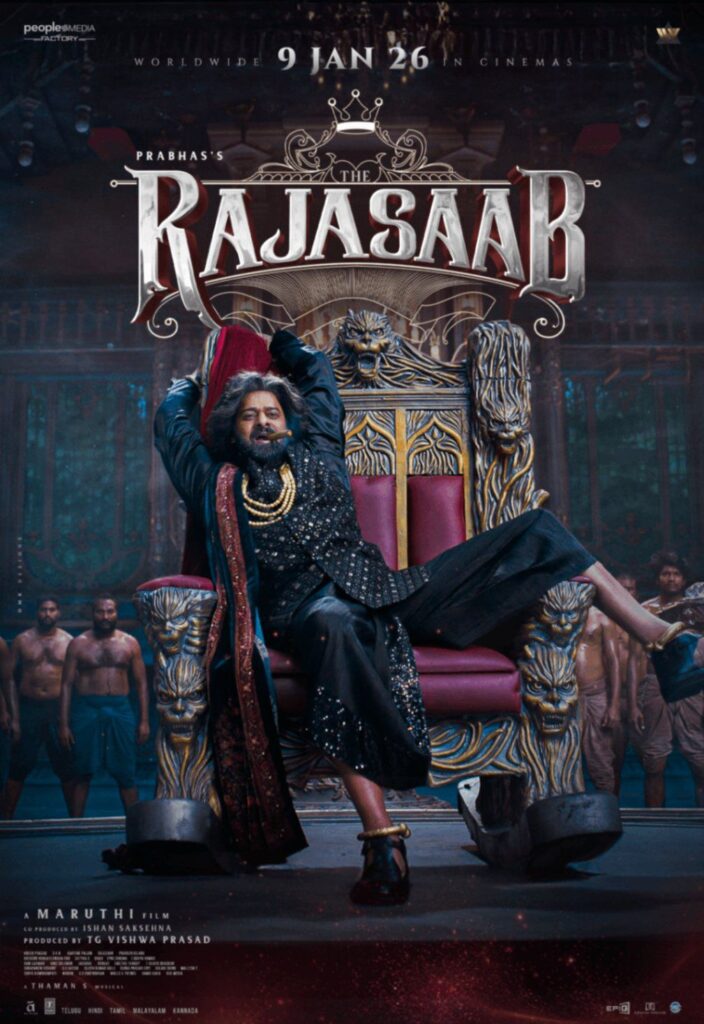
Story
The Raja Saab follows Raju (Prabhas), a warm-hearted man who dedicates his life to caring for his grandmother Gangadevi (Zarina Wahab). Suffering from Alzheimer’s, she clings to a single hope—that her long-lost husband Kanaka Raju (Sanjay Dutt), who abandoned the family years ago, will someday return. Deeply moved by her emotional condition, Raju sets out to trace his grandfather and reunite the broken family.
His search brings him to Hyderabad, where he meets Blessy (Nidhhi Agerwal) and Bhairavi (Malavika Mohanan). What starts as a heartfelt personal mission soon transforms into something far more unsettling. Raju discovers that Kanaka Raju is living in a mysterious house hidden inside the Narasapur forest, a place surrounded by chilling rumors and unexplained incidents.
As Raju digs deeper, the film shifts into a horror–mystery narrative, exploring Kanaka Raju’s true identity, the reasons behind his disappearance, and the eerie forces tied to the forest mansion. These revelations form the backbone of the film’s fantasy-horror arc.
Analysis
At its core, The Raja Saab relies on a familiar horror setup—a haunted mansion, unsettling secrets, and supernatural overtones. Director Maruthi, who earlier handled similar themes in Prema Katha Chitram, attempts to upscale this template for a star like Prabhas, blending fantasy, hypnotism, and folklore-like elements.
Conceptually, the film has a decent foundation. Themes of greed, betrayal, and generational revenge offer emotional depth, and on paper, the idea suits a larger-than-life presentation. However, the problem lies in execution.
The screenplay struggles with pacing and consistency. Frequent interruptions in the form of songs, romance, and mass moments dilute the tension that a horror film demands. The first hour in particular feels sluggish, with the narrative often stalling instead of building intrigue.
Maruthi opens the film on a promising note with the Satya episode, which effectively hints at something sinister within the mansion. Unfortunately, that eerie mood is short-lived. Once Raju’s introduction, romance, and routine commercial elements take over, the screenplay slips into a predictable pattern, losing the mystery it initially creates.
The inclusion of three heroines feels unnecessary. Instead of strengthening the narrative or reviving a “vintage Prabhas” charm, these characters remain underwritten and slow down the story. Even the romantic portions fail to register emotionally. Additionally, some of Prabhas’s dialogues sound muffled, affecting impact.
The interval block is fairly designed and brings some momentum, but the post-interval stretch again turns dull. Expectations were high for comedy, especially since Prabhas returns to humor after a long time and Maruthi is known for comic timing. Sadly, the comedy rarely works.
More disappointing is the lack of effective horror. The film struggles to create fear or suspense. Despite the setup, the danger posed by Kanaka Raju is never convincingly established. Characters inside the haunted mansion behave casually—romancing, relaxing, and joking—making it hard for the audience to feel any tension.
The film slightly redeems itself in the climax portion. From the hospital sequence onwards, the narrative gains some energy. The mind-game angle is handled better here, and the final 20 minutes are engaging compared to the rest of the film. However, this late surge is not enough to compensate for the sluggish earlier portions.
A major writing issue lies in Kanaka Raju’s characterization. He is projected as a highly intelligent, almost psychological mastermind, but eventually ends up relying on dark rituals for wealth. This contradiction weakens the earlier buildup and feels confusing.
Performances & Technical Aspects
- Prabhas looks stylish and colorful, which fans will appreciate. His performance is decent, especially in the hospital scene, but inconsistency in his look and noticeable body double usage in a few scenes break immersion. His dubbing could have been sharper.
- Malavika Mohanan gets relatively more screen time and even an action moment, while Nidhhi Agerwal and Riddhi Kumar remain underutilized.
- Sanjay Dutt feels wasted, given the potential of his role.
- Zarina Wahab delivers a sincere performance, and her character is emotionally effective.
- Despite the presence of comedians like Saptagiri, Prabhas Sreenu, Satya, the humor largely misfires.
On the technical front, the palace set is visually impressive, reflecting the film’s big budget. The VFX work is inconsistent—some scenes look good, while others feel underwhelming. Thaman’s music is a letdown; the songs fail to leave an impact, and even “Nache Nache” doesn’t create the expected theatrical buzz. The background score is often loud rather than effective.
Verdict
The Raja Saab is an average fantasy-horror film with an interesting core idea but flawed execution. While the climax offers some payoff and Prabhas’s presence adds value, weak horror elements, uneven pacing, and underdeveloped characters prevent the film from reaching its ambitious, pan-India promise.
Rating: 2.25 / 5
